
How to Use Cannabis Topicals: A Step-by-Step Beginner's Guide

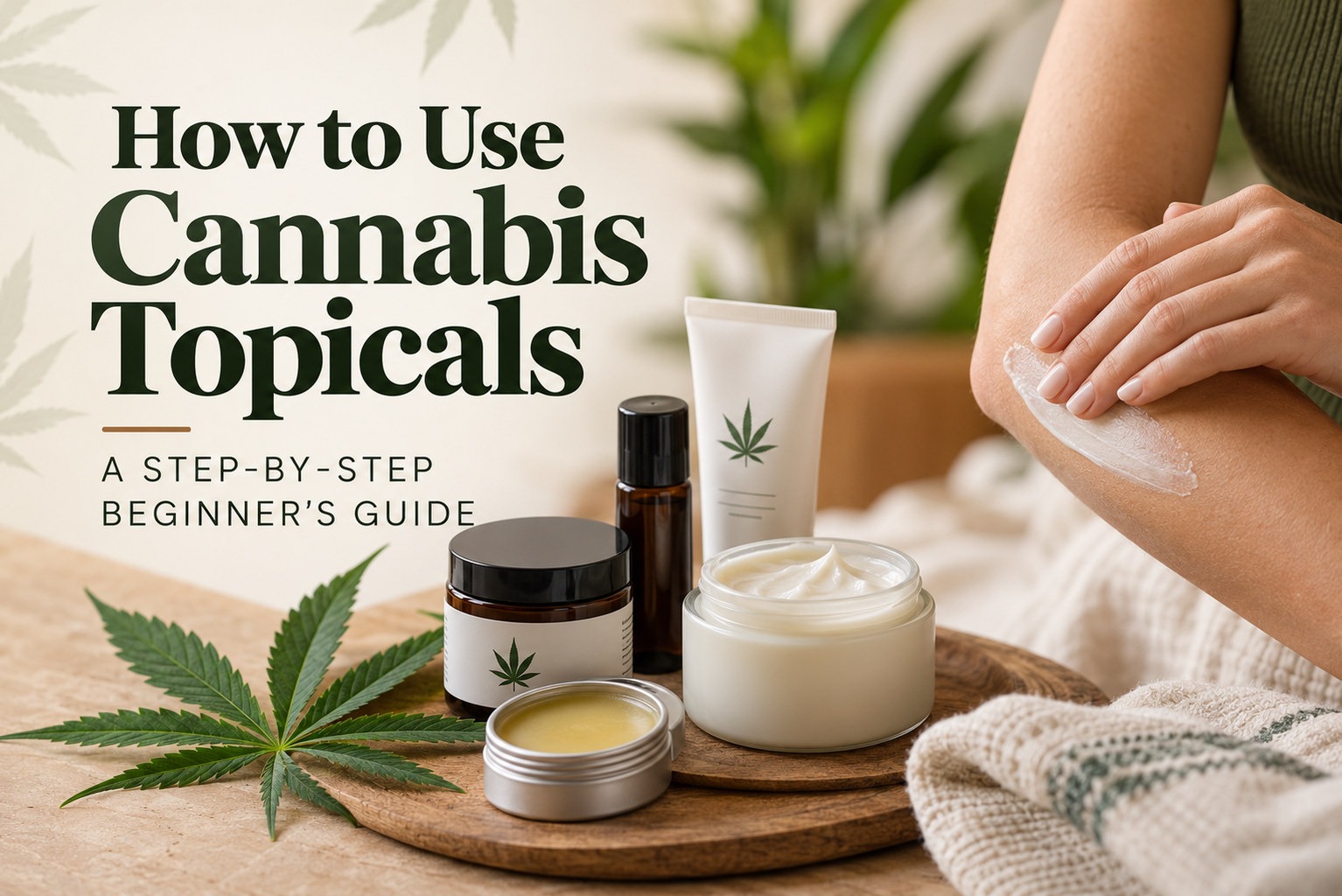
Cannabis topicals come in several forms, including creams, lotions, balms, and patches. Understanding how to use these products starts with reading their labels, identifying the ingredients, and following the correct application instructions.
Unlike cannabis flower or edibles, topicals are designed for external application. However, not all skin-applied cannabis products work the same way. Some are ordinary creams, while transdermal patches are specifically formulated to deliver ingredients through the skin.
Learning how to use cannabis topicals involves understanding these differences, checking product instructions, and recognizing important safety considerations.
This guide explains how cannabis topicals work, how to apply them, what distinguishes common product formats, and what consumers should know about THC, CBD, and skin absorption.
What Are Cannabis Topicals?
Cannabis topicals are products containing cannabis-derived ingredients that are designed for external application to the skin.
They typically combine cannabinoids with ingredients commonly found in skincare products, including oils, waxes, butters, and moisturizing agents. Some also contain fragrances, botanical extracts, menthol, or other additives.
The cannabinoids most frequently highlighted on topical labels include:
- THC (tetrahydrocannabinol): The primary intoxicating cannabinoid in cannabis. Its effects depend partly on the formulation and administration method.
- CBD (cannabidiol): A cannabinoid that does not produce the characteristic THC high, although its benefits and safety require further research.
- Other cannabinoids: Certain products contain additional cannabis compounds, depending on their formulation.
Manufacturers offer topicals in different textures and application formats. For example, a lightweight lotion may spread differently from a thick balm.
In Colorado, regulated cannabis products have specific intended-use categories. These distinctions are reflected in the state's marijuana product labeling requirements.
How to Use Cannabis Topicals: Step by Step
Applying cannabis topicals generally resembles using other skincare products. However, cannabis-containing formulations require attention to ingredient information, cannabinoid content, and manufacturer instructions.
Step 1: Read the Product Label Carefully
Before opening the package, identify the product type and its intended use. A cannabis lotion and a transdermal patch may both contain THC or CBD, but they should not be applied in the same way.
Check the following information:
- Product name and intended application method.
- Listed THC, CBD, and other cannabinoid content.
- Full ingredient information.
- Recommended quantity and application frequency.
- Warnings, restrictions, and storage directions.
- Expiration or use-by information, where provided.
Pay particular attention to warnings concerning sensitive skin or restricted application areas.
If cannabinoid measurements seem unfamiliar, The Center CO's guide to reading cannabis labels explains common THC, CBD, and packaging information. Although it uses a Michigan context, the underlying label-reading principles are useful more broadly.
Step 2: Check Ingredients and Consider a Patch Test
Before applying a new cream or balm across a large area, review the ingredient list for substances that may irritate your skin.
Some formulations contain fragrances, essential oils, menthol, or botanical extracts. These additional ingredients may matter as much as the cannabinoids themselves.
For ordinary skin-applied products, consider testing a small area of intact skin first, following the manufacturer's instructions. Watch for redness, itching, burning, or irritation.
A small-area test cannot guarantee that an allergic reaction will never occur. If you have a history of eczema, allergies, or skin sensitivity, consult a qualified healthcare professional.
Do not perform an improvised patch test with a transdermal product. Follow the specific instructions for that formulation.
Step 3: Clean and Dry the Application Area
For creams, lotions, and balms, begin with clean, dry skin unless the product instructions state otherwise.
Removing surface dirt, sweat, and other skincare products can help make application more consistent.
Avoid applying cannabis topicals to broken skin, open wounds, infected areas, or irritated surfaces unless the product instructions and a healthcare professional specifically support that use.
Step 4: Apply the Recommended Amount
Apply the quantity specified on the product label.
For a cream or lotion, this may involve spreading a thin layer across the intended area. A thicker balm or salve may require another method.
Avoid guessing an application amount based only on the advertised THC or CBD concentration. The cannabinoid quantity printed on a container does not necessarily indicate how much will be absorbed through the skin.
Use clean hands or an appropriate applicator, and avoid sharing products when doing so could contaminate the container.
Step 5: Follow the Product's Application Instructions
Some topicals are intended to be gently spread over the skin. Others have specific directions about rubbing, drying, or contact with clothing.
Follow the manufacturer's instructions rather than assuming that longer or more vigorous application improves results.
Keep the product away from the eyes, mouth, and other sensitive areas unless it is specifically labeled for those uses.
Do not heat the product, cover it with an airtight dressing, or combine it with other treatments unless the instructions or a healthcare professional direct you to do so.
Step 6: Observe Your Skin and Avoid Unnecessary Reapplication
After applying the product, pay attention to your skin's response.
Discontinue use if you notice redness, itching, swelling, burning, or other concerning reactions. Seek medical advice when appropriate.
Avoid repeatedly applying additional product simply because you do not notice an immediate effect.
The timing and duration of cannabis topical effects are not well established across formulations, according to Health Canada's cannabis administration guidance.
There is no scientifically supported universal waiting period that applies to every cannabis cream, balm, or lotion.
Step 7: Wash Your Hands and Store the Product Properly
After applying a topical, wash your hands if directed by the label, particularly before touching your eyes or preparing food.
Close the container securely and store it according to the manufacturer's recommendations.
Keep all cannabis-containing products away from children and pets. Avoid transferring them into ordinary cosmetic containers without clear identification.
Different Types of Cannabis Topicals and How They Are Used
Not all cannabis topicals have the same texture, ingredients, or application method. Understanding these differences helps consumers interpret product labels correctly.
| Topical Type | Common Characteristics | Application Considerations |
|---|---|---|
| Cannabis cream | Often thicker and moisturizing | Spread according to the product label |
| Cannabis lotion | Usually lighter and easier to distribute | May be designed for broader skin application |
| Cannabis balm | Typically contains oils and waxes | Follow directions for the intended area |
| Cannabis salve | Often thick and oil-based | Application quantity varies by formulation |
| Cannabis roll-on | Uses a roller applicator | Avoid sharing or using on damaged skin |
| Topical cannabis oil | Liquid formulation for external application | Confirm that it is labeled for topical use |
| Transdermal patch | Designed to deliver ingredients through skin | Follow precise placement, wear-time, and disposal instructions |
Product names do not always explain the complete formulation. A topical oil intended for skin application should not automatically be taken orally. Likewise, a tincture formulated for oral use is not necessarily suitable for the skin.
How Do Cannabis Topicals Work?
Cannabis topicals interact with the skin differently from inhaled or swallowed cannabis.
The skin serves as a protective barrier, limiting the passage of many substances into deeper tissue and the bloodstream. Ingredients, cannabinoid concentration, and formulation may influence how substances move through that barrier.
Researchers are studying how cannabinoids interact with processes within the skin, including components of endocannabinoid signaling.
However, these biological mechanisms do not prove that a commercial cannabis cream can treat pain, inflammation, arthritis, or other medical conditions.
Topical vs. Transdermal Absorption
The distinction between topical and transdermal products is especially important.
Conventional topicals are generally designed for application to the skin, often with a primarily local intended action.
Transdermal products are formulated to deliver ingredients across the skin barrier and potentially into systemic circulation.
Consequently, a transdermal product containing THC may behave differently from an ordinary cream containing cannabis ingredients.
The FDA's cannabis-derived product information identifies skin absorption, product quality, and long-term safety among areas requiring further research.
Do Cannabis Topicals Make You Feel High?
Whether a cannabis topical produces intoxicating effects depends on its ingredients, formulation, and ability to deliver THC into the bloodstream.
Ordinary skin-applied creams and lotions are generally not designed to produce the same systemic effects associated with inhaled or ingested THC.
However, it would be inaccurate to claim that every product labeled "topical" is guaranteed to be non-intoxicating. Transdermal products are specifically designed for a different type of absorption.
Before using a product, check:
- Whether it contains THC.
- Whether it is labeled topical or transdermal.
- Its cannabinoid content per container or application unit.
- Warnings about impairment or other potential effects.
- Manufacturer instructions for application and handling.
When product information is unclear, ask a licensed dispensary professional for clarification.
How Long Do Cannabis Topicals Take to Work?
There is no reliable universal onset time for all cannabis topicals.
Some marketing materials claim effects begin within a particular number of minutes. However, those statements should not be assumed to apply to every formulation.
Several factors can influence an individual's experience:
- Product formulation and ingredients.
- Skin characteristics and condition.
- Application area and quantity.
- Whether the product is topical or transdermal.
- Individual differences in absorption and sensitivity.
Scientific research has not established consistent onset and duration estimates across conventional cannabis topicals.
Follow product-specific application frequency instructions rather than repeatedly applying additional amounts based on an assumed waiting period.
Cannabis Topicals vs. Tinctures: What's the Difference?
Cannabis topicals and tinctures are sometimes grouped near one another in dispensary menus. However, their intended routes of administration differ.
A conventional topical is applied externally to the skin. A tincture is generally a liquid extract formulated for oral or sublingual administration, depending on its label.
| Feature | Cannabis Topicals | Cannabis Tinctures |
|---|---|---|
| Primary application | External skin application | Oral or sublingual use |
| Common formats | Creams, balms, lotions, patches | Liquid extracts in bottles |
| Ingredients | Cannabinoids with skin-product ingredients | Cannabinoids with a suitable liquid carrier |
| THC absorption | Depends on formulation; transdermal products differ | May produce systemic THC exposure |
| Important instruction | Do not ingest skin-only products | Follow oral or sublingual directions |
The table describes typical intended uses. Always follow the instructions for the specific product.
For example, a balm containing essential oils or cosmetic ingredients may not be appropriate for swallowing. Similarly, a tincture formulated for ingestion should not automatically be used as a skincare product.
The Center CO's tinctures category provides additional context for this separate product format.
Important Safety Tips When Using Cannabis Topicals
Although topical cannabis products are applied externally, they still require careful handling. A familiar skincare format does not establish that every product is suitable for every person.
Review Product Ingredients
Check for fragrances, menthol, preservatives, essential oils, and botanical extracts that may irritate sensitive skin.
Discontinue use if a product causes a concerning reaction. Seek medical attention for severe symptoms or signs of a serious allergic reaction.
Avoid Unsupported Medical Claims
Cannabis creams are sometimes promoted for pain, arthritis, inflammation, or muscle recovery. Marketing statements should not be confused with established clinical evidence.
The FDA's cannabis and CBD regulatory guidance explains the regulatory considerations surrounding cannabis-derived products that make therapeutic claims.
Do not replace prescribed medication or necessary medical care with an unapproved cannabis topical.
Consider Medications and Health Conditions
People using prescription medications, managing chronic conditions, or experiencing persistent skin problems should discuss cannabis product use with a qualified healthcare professional.
This is particularly important with transdermal products because their intended absorption differs from conventional creams.
People who are pregnant or breastfeeding should not assume cannabis-derived skin products are risk-free.
Store Products Securely
Keep products in their original packaging and away from children and animals. Avoid placing cannabis-containing creams next to ordinary household lotions where accidental use could occur.
Follow the manufacturer's temperature, storage, and expiration instructions.
Understand the Limits of Research
Evidence about topical cannabinoid absorption, long-term safety, and medical effectiveness remains incomplete.
Health Canada's cannabis consumer information describes potential risks associated with cannabis products, including skin irritation and uncertainty about effects.
Careful label reading and realistic expectations are important when comparing these products.
Frequently Asked Questions About Cannabis Topicals
1. How Much Cannabis Topical Should I Apply?
Use the amount recommended on the product label. There is no universal amount appropriate for all cannabis creams, balms, and lotions because formulations and intended uses differ.
2. Can Cannabis Topicals Make You High?
Conventional skin creams are generally not designed to produce systemic THC effects. However, transdermal formulations can behave differently. Review the specific product's cannabinoid content and warnings.
3. How Often Can You Apply Cannabis Topicals?
Application frequency depends on the product. Follow manufacturer instructions rather than adopting a universal schedule or applying excessive quantities.
4. Can You Use Cannabis Topicals on Sensitive Skin?
Some formulations contain fragrances, botanical extracts, and other potential irritants. Review ingredients and consider a small-area test for ordinary topical products. Consult a healthcare professional if you have a history of skin reactions.
5. Can Cannabis Tinctures Be Used as Topicals?
Not automatically. Tinctures are usually designed for oral or sublingual administration, while topicals are formulated for skin application. Always follow the product's intended use.
6. Are Cannabis Topicals Proven to Relieve Pain?
Research remains limited, and medical benefits have not been reliably established across commercial cannabis topical products and medical conditions. They should not replace appropriate medical care.
Final Thoughts
Learning how to use cannabis topicals begins with understanding the product rather than following a single application routine.
Creams, lotions, balms, and patches may contain similar cannabinoids, but their ingredients, absorption characteristics, and intended uses can differ.
Reading labels, checking for potential irritants, preparing the skin appropriately, and following product-specific directions are important parts of responsible product handling.
Consumers should also recognize that conventional topicals and transdermal products are not interchangeable. The formulation can influence cannabinoid absorption and potential systemic effects.
Most importantly, a cannabis topical should not be evaluated solely by its THC or CBD content or claims of immediate relief.
For adults exploring skin-applied cannabis products, The Center CO's topicals category provides a starting point for reviewing currently listed products, subject to availability.