How to Read a Cannabis Label: THC, CBD, and Other Important Details

by The Center Co Team | October 13, 2026
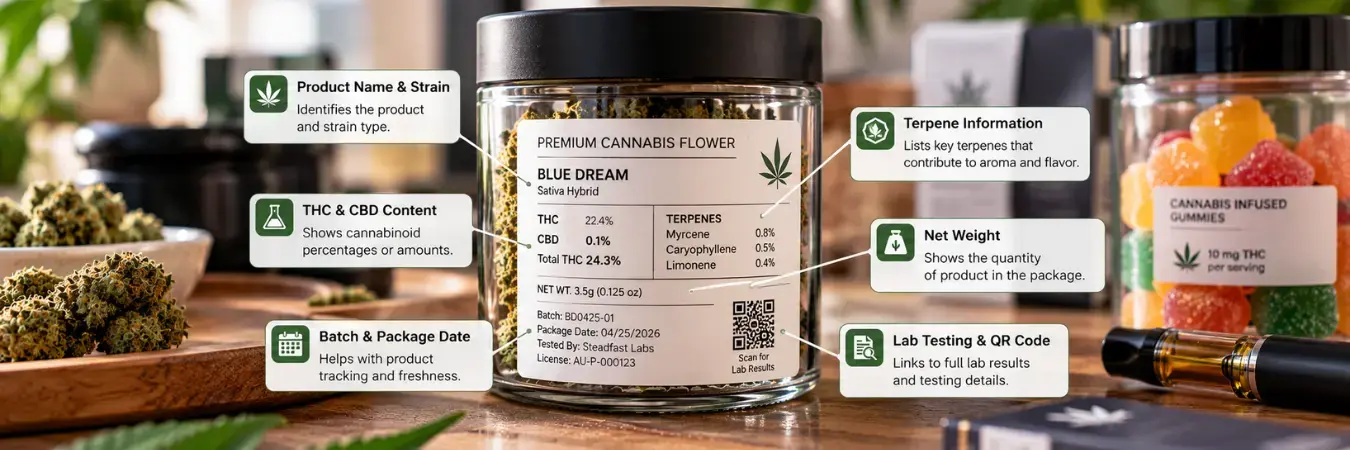
When comparing cannabis products, THC percentage is often the first number that catches your attention. But it tells only part of the story. Two products with similar THC levels can differ in their CBD content, cannabinoid profiles, ingredients, and overall formulation. Understanding these differences starts with knowing what to look for on the label.
Cannabis labels aren't always straightforward. Flower typically lists potency in percentages, while edibles use milligrams per serving. You may also come across terms like THCA, total THC, terpene profiles, and batch numbers, each providing useful information about the product.
For Michigan cannabis consumers, knowing how to read a cannabis label makes it easier to compare products, understand potency, and recognize important testing and safety details before making a purchase.
This guide breaks down the information found on cannabis labels, from THC and CBD measurements to serving sizes, laboratory results, and product dates, so you can better understand what you're buying.
Why Is It Important to Read Cannabis Labels?
Cannabis products can vary significantly in potency, ingredients, cannabinoid composition, and consumption methods. Two products with similar names or appearances may have entirely different chemical profiles.
Understanding cannabis labels helps consumers:
- Identify cannabinoid content: Understand how much THC, CBD, and other cannabinoids a product contains.
- Compare product potency: Evaluate cannabinoid concentrations using appropriate measurements.
- Understand serving sizes: Distinguish between THC per serving and total THC per package.
- Review safety information: Identify ingredients, allergens, warnings, and consumption precautions.
- Verify product testing: Find laboratory details, batch numbers, and tracking information.
- Make informed comparisons: Evaluate products beyond strain names and marketing descriptions.
In Michigan, licensed cannabis products must comply with labeling and testing requirements established by the Michigan Cannabis Regulatory Agency (CRA).
What Information Is Found on a Cannabis Label?
Cannabis packaging generally contains several types of product information. Some details are required by Michigan regulations, while manufacturers may voluntarily provide additional information.
Label Information | What It Tells You |
Product Name | Identifies the cannabis product or strain |
THC Content | Indicates the amount or concentration of THC |
CBD Content | Shows the amount or concentration of CBD |
Net Weight | Specifies the quantity of product in the package |
Serving Size | Identifies cannabinoid content per serving |
Ingredients | Lists ingredients used in manufactured products |
Testing Information | Identifies the testing laboratory and related details |
Batch or Tracking Number | Supports product identification and traceability |
Product Dates | Shows relevant harvest, production, or packaging dates |
Safety Warnings | Communicates important health and legal precautions |
The exact presentation depends on whether the product is cannabis flower, an edible, a concentrate, or another manufactured cannabis product.
Understanding THC Content on Cannabis Labels
THC, or tetrahydrocannabinol, is the primary intoxicating cannabinoid associated with cannabis.
THC information is commonly displayed prominently on cannabis packaging. However, understanding the measurement is more important than simply identifying the highest number.
What Does THC Percentage Mean?
THC percentage represents the proportion of a product's weight made up of THC.
For example, cannabis flower labeled 20% THC contains approximately 200 milligrams of THC per gram, based on the reported concentration.
THC Percentage | Approximate THC per Gram |
10% THC | 100 mg |
15% THC | 150 mg |
20% THC | 200 mg |
25% THC | 250 mg |
30% THC | 300 mg |
These figures describe cannabinoid content, not the amount absorbed by the body during consumption.
Actual exposure depends on the consumption method, product characteristics, and individual factors.
THC Percentage vs. THC Milligrams
THC percentages and milligrams communicate different measurements.
- THC percentage (%): Commonly used for cannabis flower and concentrates to indicate cannabinoid concentration by weight.
- THC milligrams (mg): Commonly used for edibles, beverages, capsules, and tinctures to indicate specific cannabinoid quantities.
For example, a package containing ten gummies with 10 mg THC each contains 100 mg THC in total.
Understanding the difference between individual servings and total package content is especially important for edible products.
What Is Total THC?
Some cannabis labels distinguish between delta-9 THC, THCA, and total THC.
THCA is a naturally occurring cannabinoid precursor that can convert into THC when exposed to heat through a process called decarboxylation.
A commonly used theoretical calculation is:
Total THC = Delta-9 THC + (THCA × 0.877)
For example, a product containing 2% delta-9 THC and 20% THCA has a calculated potential total THC of approximately 19.54%.
This calculation estimates potential THC content rather than the amount actually delivered or absorbed during consumption.
Does Higher THC Mean Better Cannabis?
Not necessarily. Higher THC concentrations can increase the potential for stronger intoxicating effects, but THC percentage alone does not determine overall product quality.
Other factors include:
- Cannabinoid composition and formulation.
- Product freshness and storage conditions.
- Terpene profile and aromatic characteristics.
- Consumption method and individual tolerance.
Consumers should evaluate THC alongside other product information rather than using potency as the only purchasing criterion.
How to Read CBD Content on Cannabis Labels
CBD, or cannabidiol, is another naturally occurring cannabinoid found in cannabis and hemp.
Unlike THC, CBD does not generally produce the intoxicating high associated with marijuana.
CBD content may be displayed as a percentage, milligrams per serving, or total milligrams per package.
For example:
- 5% CBD flower: Approximately 50 mg CBD per gram.
- 300 mg CBD oil in a 30 mL bottle: Approximately 10 mg CBD per mL.
- 10 mg CBD edible: Contains 10 mg CBD per stated serving.
CBD-focused products may still contain THC. Consumers should review both cannabinoid measurements rather than relying solely on product descriptions.
Understanding THC-to-CBD Ratios
Some cannabis labels describe cannabinoid composition using ratios such as 1:1, 2:1, or 10:1.
Example Ratio | Meaning |
THC 1:1 | Equal quantities of THC and CBD |
THC 2:1 | Twice as much THC as CBD |
CBD 2:1 | Twice as much CBD as THC |
CBD 10:1 | Ten times as much CBD as THC |
The order of cannabinoids matters. Always check the actual milligram amounts because ratios describe composition rather than guaranteed effects.
The U.S. Food and Drug Administration also notes that CBD may cause side effects and interact with certain medications.
Other Cannabinoids Found on Cannabis Labels
Cannabis contains numerous cannabinoids beyond THC and CBD. Some manufacturers include expanded cannabinoid profiles on packaging or laboratory reports.
Cannabinoid | What to Know |
CBG (Cannabigerol) | A naturally occurring cannabinoid under ongoing scientific investigation |
CBN (Cannabinol) | Can form as THC undergoes oxidation and degradation |
CBC (Cannabichromene) | A non-intoxicating cannabinoid being studied for its properties |
THCV (Tetrahydrocannabivarin) | A cannabinoid structurally related to THC with distinct characteristics |
THCA (Tetrahydrocannabinolic Acid) | A cannabinoid precursor that can convert into THC through heating |
These compounds provide additional information about a product's chemical composition. However, their presence does not establish specific medical benefits or guarantee particular effects.
What Do Terpene Percentages Mean on Cannabis Labels?
Terpenes are aromatic compounds found in cannabis and many other plants. They contribute to the distinctive scents and flavors of different cannabis varieties.
Some cannabis labels include individual terpene percentages or a complete terpene profile.
Common examples include:
- Myrcene: Commonly associated with earthy and herbal aromas.
- Limonene: Known for citrus-like aromatic characteristics.
- Pinene: Associated with pine-like scents.
- Linalool: Commonly associated with floral or lavender-like aromas.
- Caryophyllene: Known for peppery and spicy aromatic characteristics.
Terpene information can help consumers compare product aroma profiles. However, specific effects cannot reliably be predicted from terpene content alone.
Research into cannabinoid and terpene interactions remains ongoing.
How to Read Cannabis Labels by Product Type
Different cannabis categories use different labeling conventions. Understanding these differences makes product comparisons more meaningful.
Product Type | Common Potency Measurement | Important Details to Check |
Cannabis Flower | THC and CBD percentages | Cannabinoid profile, weight, testing, harvest date |
Cannabis Edibles | Milligrams per serving | Serving size, total package THC, ingredients |
Cannabis Concentrates | Cannabinoid percentages | THC concentration, weight, testing details |
Cannabis Vapes | Percentages or milligrams | Cannabinoid content, ingredients, formulation, testing |
Cannabis Tinctures | Milligrams per mL or serving | Total cannabinoid content, concentration, serving instructions |
Cannabis Flower Labels
Flower packaging commonly emphasizes THC percentage, CBD percentage, strain name, and net weight.
Some products also display harvest dates and terpene profiles.
Consumers should compare the full cannabinoid profile and available testing information rather than focusing exclusively on THC percentage.
Cannabis Edible Labels
Edible packaging generally emphasizes THC and CBD content in milligrams.
The most important distinction is between THC per serving and total THC per package.
For example, a chocolate bar containing 100 mg THC divided into ten equal servings provides 10 mg THC per serving.
Edibles also have delayed effects compared with inhaled cannabis. Effects may take 30 minutes to two hours to begin, sometimes longer, and may last several hours. Consumers should follow product instructions and avoid taking additional servings while waiting for effects.
Cannabis Concentrate and Vape Labels
Concentrates and vape products often contain higher cannabinoid concentrations than cannabis flower.
Their packaging may identify THC percentage, CBD content, net weight, formulation, and testing details.
Terms such as distillate, live resin, and rosin describe differences in processing or formulation. They do not independently guarantee product quality or safety.
Understanding Cannabis Lab Testing in Michigan
Cannabis products sold through Michigan's licensed regulated market must undergo applicable compliance testing before retail sale.
Testing helps verify cannabinoid concentrations and evaluate whether products meet established safety standards.
Depending on the product and regulatory requirements, testing may evaluate:
- Cannabinoid potency: THC, CBD, and other relevant cannabinoid concentrations.
- Pesticide residues: Regulated pesticide contamination.
- Heavy metals: Potential contamination from certain metals.
- Microbial contamination: Relevant microorganisms and microbial hazards.
- Residual solvents: Solvents remaining from applicable extraction processes.
- Other contaminants: Additional substances covered by Michigan testing requirements.
The CRA oversees licensed safety compliance facilities responsible for conducting regulated cannabis testing.
What Is a Certificate of Analysis (COA)?
A Certificate of Analysis is a laboratory report documenting testing results for a particular cannabis sample or product batch.
A COA may include:
- Testing laboratory name.
- Sample or batch identification.
- Testing date.
- Cannabinoid potency results.
- Relevant contaminant testing results.
- Compliance findings.
Consumers should verify that the laboratory report corresponds to the product or batch being purchased.
Compliance testing provides important product information, but it does not mean cannabis consumption is risk-free.
For additional information, visit the Michigan Cannabis Regulatory Agency.
What Do Batch Numbers, Metrc Tags, and Product Dates Mean?
Cannabis labels may contain identification numbers and dates that help document a product's history.
Label Detail | Purpose |
Batch or Lot Number | Identifies a specific production group |
Metrc Package Identifier | Supports product tracking within Michigan's regulated supply chain |
Harvest Date | Identifies when cannabis flower was harvested |
Production Date | Indicates when a manufactured product was produced |
Packaging Date | Shows when the product was packaged |
Expiration Date | Identifies the labeled expiration date, when applicable |
Michigan uses the Metrc seed-to-sale tracking system to support inventory traceability throughout the licensed cannabis supply chain.
Product dates can provide useful context when evaluating freshness, although actual product condition also depends on packaging, handling, and storage.
A recent packaging date does not necessarily mean a recent harvest date.
Cannabis Warning Labels and Michigan's Universal Symbol
Michigan cannabis packaging must include required regulatory information and applicable safety warnings.
The state's universal cannabis symbol helps identify regulated cannabis products containing THC.
Warnings commonly address:
- Age restrictions for adult-use cannabis.
- Impaired driving and operating machinery.
- Keeping cannabis away from children.
- Pregnancy and breastfeeding precautions.
- Other product-specific health and safety considerations.
Manufactured products may also require ingredient and allergen information.
Consumers should review all applicable warnings, particularly when purchasing an unfamiliar product.
Common Mistakes to Avoid When Reading Cannabis Labels
Even experienced consumers can misinterpret packaging information.
Common mistakes include:
- Focusing only on THC percentage: Potency does not describe every product characteristic.
- Confusing package THC with serving THC: Particularly important for edibles.
- Ignoring CBD content: Products may contain multiple cannabinoids.
- Overlooking ingredients: Manufactured products may contain allergens or other ingredients.
- Assuming terpene profiles guarantee effects: Aroma compounds do not reliably predict individual experiences.
- Skipping testing information: Laboratory and batch details provide valuable product context.
Reviewing the complete label helps consumers avoid relying on a single number or marketing claim.
How to Compare Cannabis Products Using Their Labels
A practical comparison begins with identifying the product type and its intended consumption method.
Before purchasing, consider this checklist:
1. Identify the product category: Flower, edible, concentrate, vape, or tincture.
2. Compare THC and CBD content: Use equivalent measurements when evaluating similar products.
3. Check serving information: Distinguish individual servings from total package content.
4. Review ingredients and warnings: Identify relevant safety considerations.
5. Check laboratory information: Look for testing details and product identification.
6. Consider product dates: Review harvest, production, packaging, or expiration information where available.
At The Center, understanding cannabis labels can help Michigan shoppers evaluate products with clearer expectations and more informed questions.
Frequently Asked Questions About Cannabis Labels
1. What is the most important information on a cannabis label?
THC and CBD concentrations, serving information, ingredients, testing details, and safety warnings are among the most important elements. Their importance depends on the product category.
2. What does 20% THC mean on a cannabis label?
It indicates approximately 200 mg THC per gram of product, based on the reported concentration. This does not represent the amount absorbed during consumption.
3. What is the difference between THC and total THC?
THC may refer to measured delta-9 THC, while total THC commonly includes a calculated contribution from THCA that can convert into THC when heated.
4. Are cannabis products in Michigan lab-tested?
Yes. Cannabis products sold through Michigan's licensed regulated market are subject to applicable compliance testing requirements before retail sale.
5. Does higher THC mean better cannabis?
Not necessarily. THC concentration is only one product characteristic. Quality and individual experience depend on additional factors, including formulation, product condition, and personal sensitivity.
6. Why do cannabis edibles list THC in milligrams?
Milligrams indicate the quantity of THC in a serving or package, making it easier to distinguish between individual portions and total cannabinoid content.
Final Thoughts: Understanding Cannabis Labels Before You Buy
Knowing how to read a cannabis label helps consumers understand what is inside a product rather than relying exclusively on strain names, THC percentages, or promotional descriptions.
THC and CBD concentrations, serving sizes, laboratory testing information, ingredients, product dates, and safety warnings each provide valuable insights.
For Michigan consumers, understanding these details is an important part of comparing products available through licensed dispensaries.
By reviewing the complete label and recognizing how different measurements apply to different cannabis categories, shoppers can make more informed purchasing decisions.
Disclaimer: This article is intended for general educational purposes and does not constitute medical or legal advice. Cannabis can impair judgment and coordination and carries health risks. Adult-use cannabis is restricted to individuals aged 21 and older in Michigan. Follow applicable laws, product instructions, and safety warnings.